The one-horned rhinoceros in Nepal: from 100 to 752
In 1966, Nepal had perhaps 100 wild rhinos. They were confined to a stretch of Terai floodplain south of Kathmandu that had once held thousands across a much larger range. The species — Rhinoceros unicornis, the greater one-horned rhinoceros — looked likely to follow the Javan and Sumatran rhinos toward extinction in its smallest country of occurrence.
In 2021, Nepal counted 752. The recovery is one of the most consequential in Asian conservation. It is also, like the parallel tiger story, unfinished.
The species
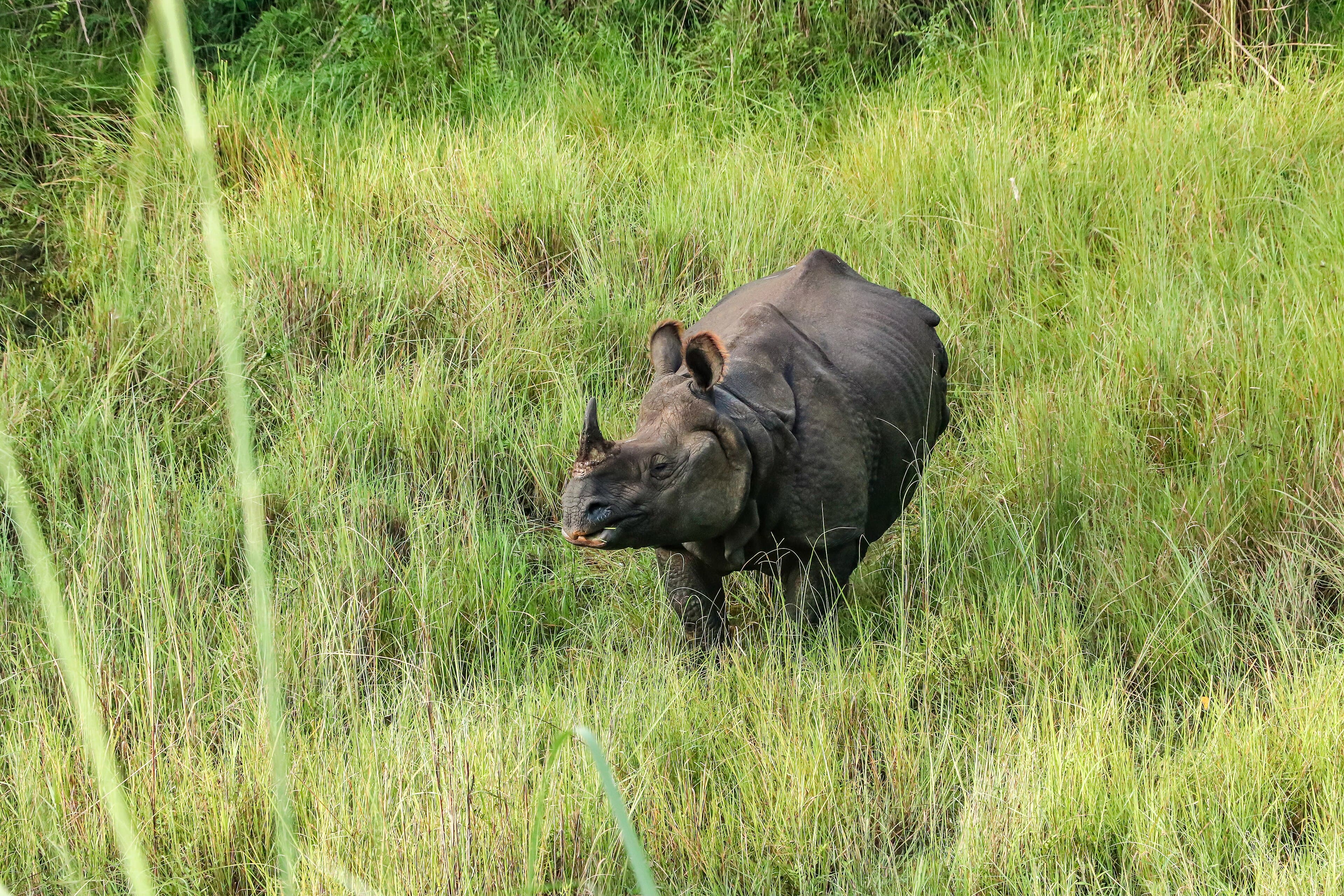
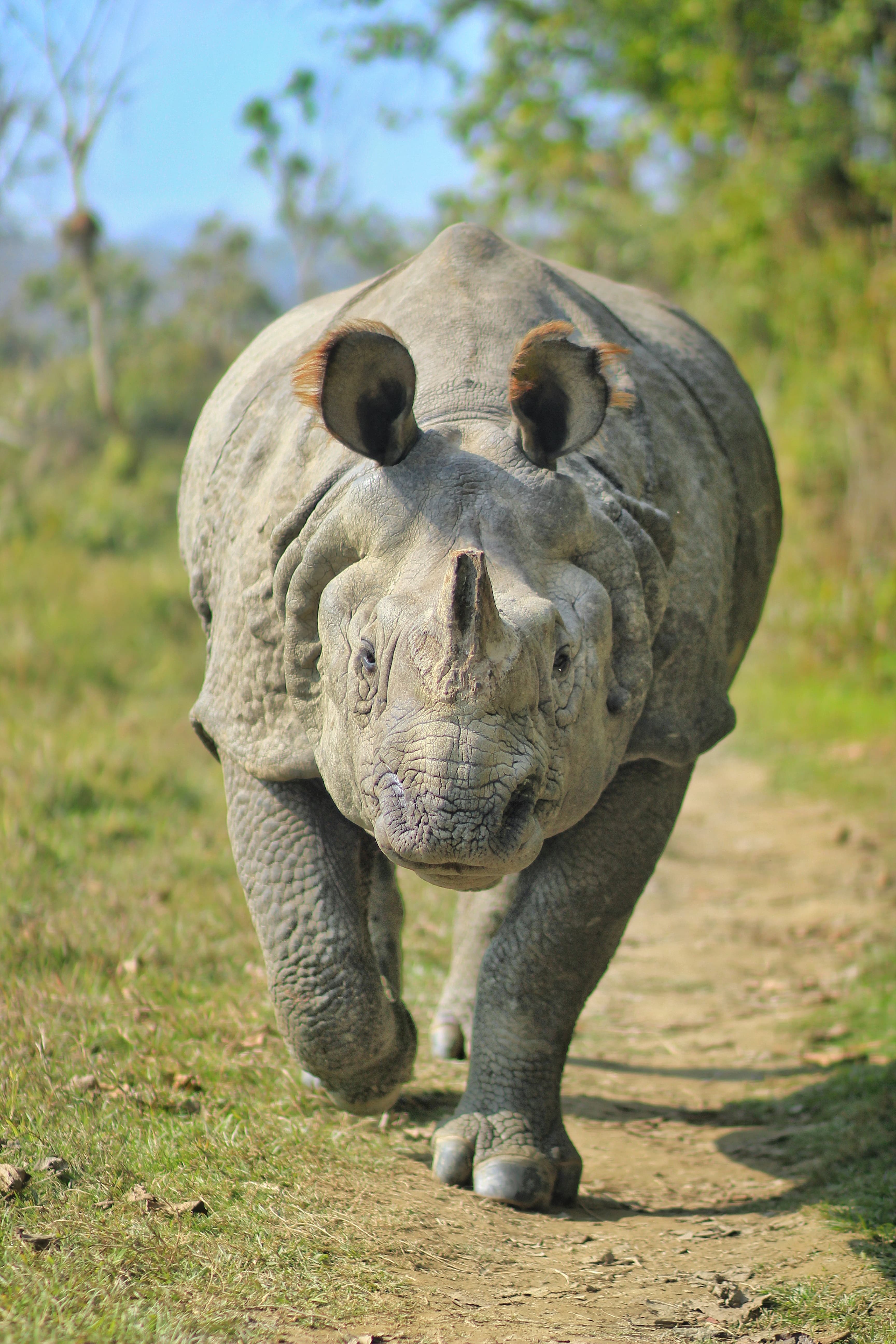
The greater one-horned rhinoceros — also called the Indian rhinoceros — is the largest of the three Asian rhino species and the second-largest land mammal in Asia after the elephant. Adult males weigh up to 2,200 kg; a single black horn, 20 to 60 cm long, is shared by both sexes. The skin is plate-thick and folded into broad armoured panels with pink wrinkles between, giving the species its unmistakable prehistoric silhouette.
Rhinos are largely solitary — bulls hold loose, overlapping home ranges, and adult females are usually accompanied only by their most recent calf. They are strong swimmers and spend much of the heat of the day wallowing in water and mud, which cools them and rids them of biting insects and parasites. They are generally placid animals, but can charge with surprising speed when surprised or when a calf is near. This is the practical safety briefing every visitor walking in rhino country is given: keep distance, do not run, listen to your guide.
Their diet is voluminous and varied — predominantly grasses (especially the tall floodplain grasses of the Terai), with leaves, fruits, branches, sedges, ferns, and aquatic plants. In buffer zones they will raid rice, wheat, maize, and lentil fields. This single behaviour is the most consistent source of human-rhino conflict in Nepal.
The species is classified as Vulnerable on the IUCN Red List. The global wild population is roughly 4,000 animals — found only in Nepal and northeast India.
The crash, and what nearly happened
Until the early twentieth century, the greater one-horned rhinoceros ranged across the entire alluvial plain of the Indus, Ganges, and Brahmaputra rivers — from Pakistan through India to Bangladesh and the Terai of Nepal. The combination of habitat conversion for agriculture, organised sport hunting under the colonial and royal Nepali aristocracies, and after the 1950s a wave of poaching driven by the medicinal trade in rhino horn collapsed that range to a few isolated populations.
In Nepal, the rhinos were concentrated in a stretch of Terai jungle that the Rana rulers had reserved as a private hunting ground. After 1950, when Nepal opened to the outside world, that protection collapsed. Malaria-eradication programmes in the 1950s opened the Terai to settlement by hill farmers; the rhino's habitat shrank as the human population grew. By 1966 the rhino population was estimated at around 100 animals, all in the area that would later become Chitwan National Park.
If nothing had changed, they would have been gone within a generation.
What changed
Several things, in sequence, and most of them controversial at the time:
Gaida Gasti. In 1961, before the formal park existed, Nepal established an armed rhino patrol called Gaida Gasti — literally "Rhino Patrol" — to interdict poachers in the Chitwan area. It was the first organised wildlife enforcement of its kind in Nepal.
Chitwan National Park (1973). Following a 1970 royal recommendation, Chitwan was declared Nepal's first national park, with the Nepal Army deployed to enforce its boundaries. The park was carved out of land that local Tharu communities had occupied; their displacement is part of the story too, and the site does not pretend otherwise. The army deployment, costly and politically heavy, became the template for Nepali protected-area management.
UNESCO World Heritage status (1984). Chitwan was inscribed on the World Heritage List, anchoring international support and recognition. The status, ID 284, is one of only two World Heritage sites among Nepal's national parks (the other is Sagarmatha).
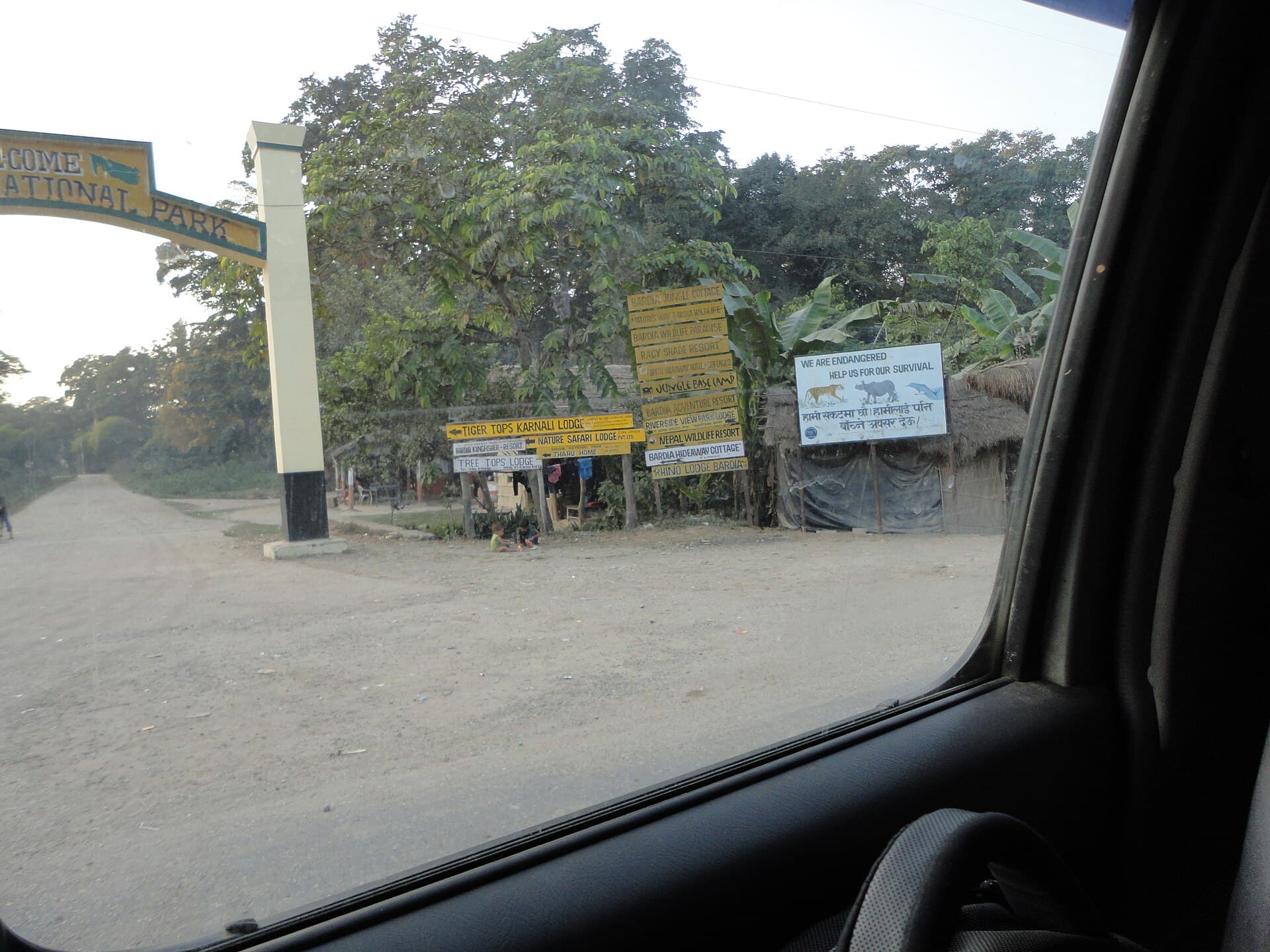
Translocation as insurance. By the mid-1980s, conservation planners understood that a single population — however well-protected — was vulnerable to a single catastrophe. In 1986 the first rhinos were translocated from Chitwan to Bardiya National Park in the west, beginning a programme that would continue for decades.
The translocation record is now extensive:
- Chitwan → Bardiya (1986–2003): 87 rhinos relocated to establish a second viable population in the Karnali floodplain.
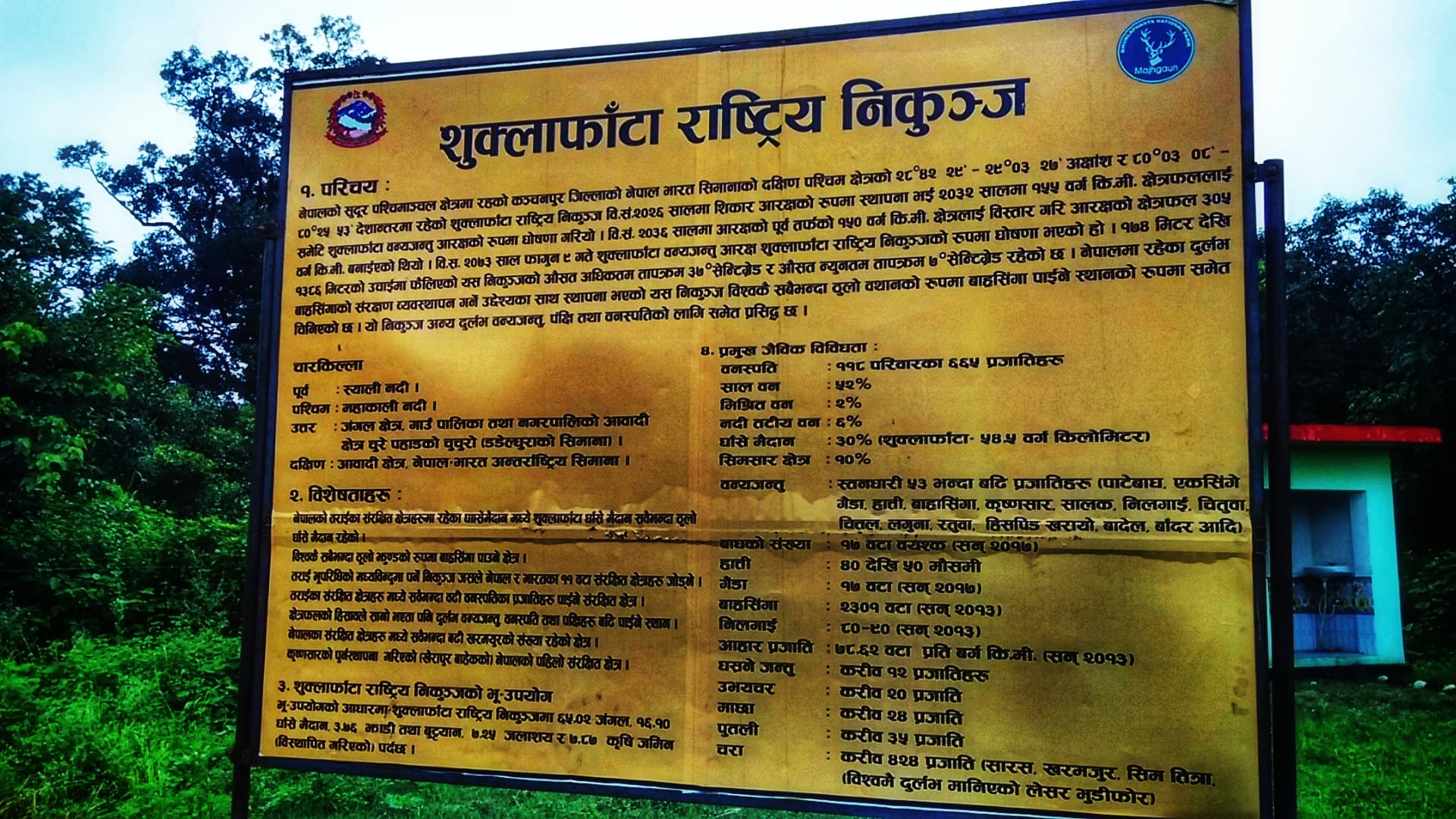
- Chitwan → Shuklaphanta (2003): 4 rhinos as a third-population seed.
- Chitwan → Shuklaphanta (2017): 5 further rhinos to reinforce.
- Chitwan → Bardiya (Babai Valley) (2016–2017): 8 rhinos moved to repopulate the Babai Valley after the insurgency-era poaching had wiped out the earlier-translocated population there.
- Chitwan → Koshi Tappu (2023): 2 rhinos as the first reintroduction to Koshi Tappu Wildlife Reserve, which had no resident rhinos.
By 2023, DNPWC records counted 109 rhinos relocated within Nepal across 38 years of translocation work, plus 26 rhinos gifted to other countries (the first batch of four to India's Dudhwa National Park in 1985).
Community-based conservation. From the 1990s onward, buffer-zone user committees, revenue-sharing arrangements that returned a portion of park revenue to local communities, and ecotourism-linked livelihood programmes shifted the local relationship to rhinos. Tourism in Sauraha is built on rhino visibility; the village's economic interest aligned, however imperfectly, with the rhino's survival.
The two great threats — and one near-disaster
The recovery has not been smooth. Two periods nearly undid it.
The Maoist insurgency (1996–2006). During Nepal's decade-long armed conflict, anti-poaching capacity collapsed across rural areas. Army units were redeployed to counter-insurgency duties; patrol intelligence networks broke down. Poaching surged. In Bardiya, the translocated population in the Babai Valley — the result of fifteen years of careful relocation work — was reduced to almost zero between 2002 and 2006. The 2007 count for Bardiya was 31 rhinos, down from 67 in 2000. The decade undid decades of work.
Recurring poaching pressure. Even after the conflict ended, demand for rhino horn — driven primarily by traditional-medicine markets in China and Vietnam, where the horn is falsely believed to have therapeutic properties — has periodically broken through. Nepal has responded with intensified army patrols, technology investment (camera traps, drone surveillance, real-time intelligence), and prosecutions. The country has notched several recent zero-poaching years, a measure considered nearly impossible elsewhere in the rhino's range.
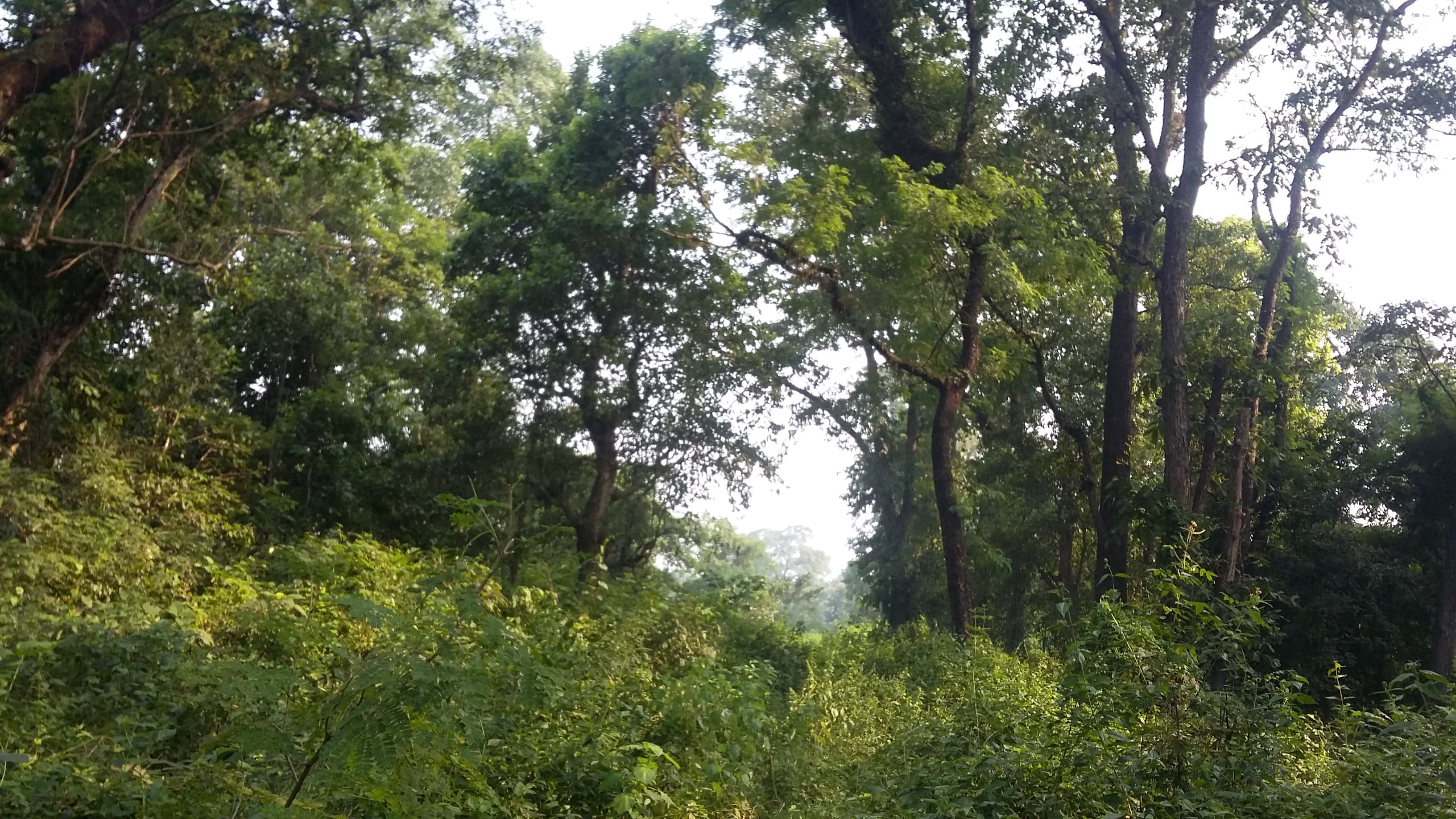
The Mikania problem is more recent. Mikania micrantha, an invasive vine from South America, now smothers grassland and riverine forest across Chitwan's prime rhino habitat. Rhinos cannot eat it; it forms thick mats that suppress the floodplain grasses they depend on. Habitat-management responses are active but the vine spreads faster than the manual removal that controls it.
The numbers, census by census
Nepal's rhino census uses direct observation from elephant-back rather than camera trapping — surveyors on domesticated elephants sweep the habitat in coordinated blocks, identifying each rhino by sex, age, and physical markings. It is laborious and dangerous (a researcher was killed during the 2021 count), but it produces individually-identified counts rather than statistical estimates.
The figures from the major census years:
- 1966: ~100 rhinos (rough estimate, pre-systematic surveys)
- 2005: 409 rhinos
- 2015: 645 rhinos
- 2021: 752 rhinos
The 2021 distribution across the four rhino-holding parks:
- Chitwan: 694 rhinos
- Bardiya: 38 rhinos
- Shuklaphanta: 17 rhinos
- Parsa: 3 rhinos
The Chitwan figure deserves underlining. It makes Chitwan's the second-largest one-horned rhino population on Earth, behind only Kaziranga National Park in Assam, India. For a country of Nepal's size and resources, that is an extraordinary outcome.
The new problem: too many rhinos, in the wrong place
In 2024, Nepal's Department of National Parks and Wildlife Conservation announced an unusual programme: the internal translocation of rhinos within Chitwan itself, from the park's overcrowded western sector to the less-populated east. The rationale was that rhino density in the western sector had risen above the habitat's carrying capacity, that mortality rates were rising as a result, and that better distribution would reduce poaching risk and flood-related deaths.
The decision has been contested. Tourism operators in the western sector — whose livelihoods depend on tourists coming to see rhinos — argue that the translocation will hurt their businesses and that the underlying ecological analysis has not been adequately published. Some conservationists agree that the case is not yet clear-cut. The first six rhinos were translocated in March 2024, with more planned.
This kind of debate is, in its way, a marker of success. A country that fifty years ago was struggling to keep a hundred rhinos alive is now arguing about how to distribute nearly seven hundred of them. That argument is a victory disguised as a problem.
The 2026 census
Nepal's next national rhino count was scheduled for March 2025 but was rescheduled due to the national elections of March 2026. As of mid-2026 the count remains planned but the date is not yet finalised. It will cover Chitwan, Parsa, Shuklaphanta, and Koshi Tappu (which received its first rhinos in 2023). When the new figures are released, this page will be updated.
Like the tiger count, the rhino count is the heartbeat of Nepali conservation — every few years, the country looks at how it is doing and adjusts. The first numbers, in 1966, were a near-obituary. The last numbers, in 2021, were 752. The next ones will reveal whether the recovery continues, or whether the new pressures — habitat loss, climate shifts in the floodplains, the persistent shadow of poaching — have begun to tell.
Related on this site: Chitwan · Bardiya · Shuklaphanta · Parsa · The Bengal tiger in Nepal · Where to see a one-horned rhino in Nepal
Sources & further reading:
- National Rhino Count 2021, National Trust for Nature Conservation (NTNC) and Department of National Parks and Wildlife Conservation (DNPWC), April 2021.
- DNPWC translocation records, summarised in The Himalayan Times, April 2024.
- Reporting in Mongabay News, Dialogue Earth, and Kathmandu Post on the conservation history, the insurgency-era poaching collapse in Bardiya's Babai Valley, the 2023 Koshi Tappu reintroduction, and the 2024 internal-translocation controversy.
- IUCN Red List assessment for Rhinoceros unicornis.
- Status of Greater One-Horned Rhinoceros in Nepal, peer-reviewed analysis in Global Ecology and Conservation (2017).
- UNESCO World Heritage citation for Chitwan National Park (ID 284, inscribed 1984).
All figures verified against published sources, June 2026. Population numbers from the 2021 census; this page will be updated as new census results are released.