The Bengal tiger in Nepal: a story of doubling
In 2010, Nepal had 121 wild tigers. By 2022, it had 355. No other country in the world met the global goal of doubling its tiger population in twelve years. Nepal did it nearly three times over.
This is the story of how — what changed in policy, in the parks, in the relationships between Nepali communities and a species that can kill them. It is also the story of what is being asked of the country next, because tiger recovery does not end at doubling. It begins there.
The species
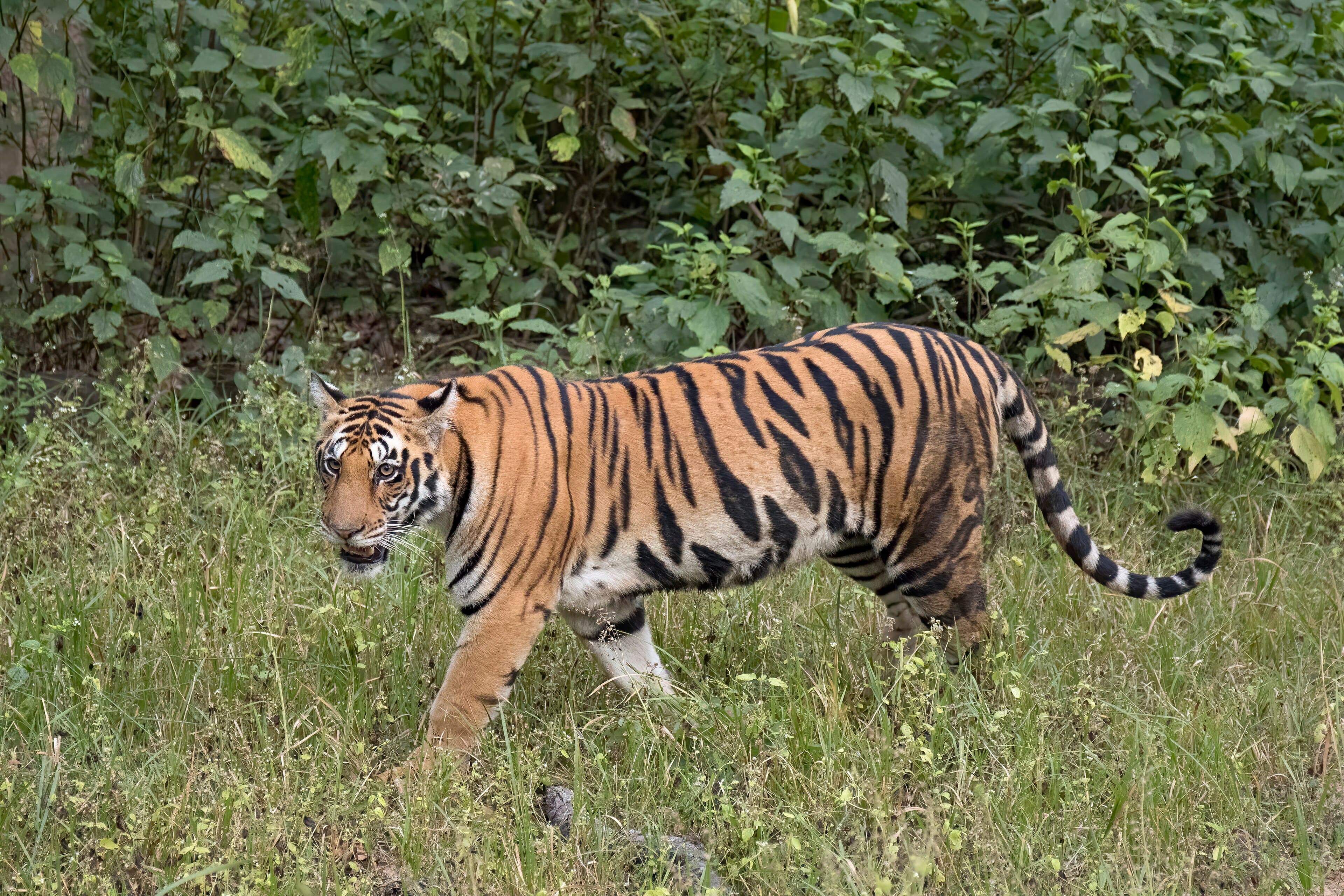
The Bengal tiger (Panthera tigris tigris) is the largest cat in Asia and the largest tiger subspecies. Adult males in Nepal's Terai weigh roughly 200–260 kg; females are smaller. A tiger's home range varies with prey density — in Chitwan, where deer are plentiful, males may hold ~50–100 km² and females ~10–20 km², overlapping with several females' ranges.
Tigers are solitary, territorial, and largely nocturnal and crepuscular — they actively avoid the times and places people are present, which is why daytime sightings are so rare even where tigers are abundant. They are ambush predators, depending on dense cover to approach prey within a final, explosive rush. Their diet in Nepal is principally deer — chital (spotted deer), sambar, and hog deer — and wild boar; abundant prey means Nepali tigers rarely turn to unusual food, though human-conflict cases involving livestock and (tragically) people do occur in buffer-zone areas.
The Bengal tiger is classified as Endangered on the IUCN Red List. The total wild population worldwide is estimated at fewer than 4,000 mature individuals.
The starting point: 100 tigers, and falling
Nepal began scientific tiger counts in the late 1990s. The numbers from the early years tell the story of a population under sustained pressure:
- 1995: 98 tigers
- 2000: 109 tigers
- 2005: 126 tigers
- 2009: 121 tigers
This was a country with five potential tiger parks (Chitwan, Bardiya, Banke, Parsa, Shuklaphanta), a long-standing protected-area system, and a Nepal Army deployment in each major park — and the trajectory was barely above replacement. The threats were the familiar ones: poaching for the international trade in tiger parts, habitat fragmentation, prey-base depletion from livestock pressure in buffer zones, and an armed conflict between 1996 and 2006 that thinned anti-poaching capacity across rural Nepal.
By 2009, when the global conservation community gathered to confront the tiger crisis, Nepal's wild population was about a third of what its parks could potentially carry. The next decade would change that.
The TX2 goal — and what Nepal did with it
In November 2010, the heads of state of the thirteen tiger-range countries met in St Petersburg and committed to a single, audacious goal: double the world's wild tiger population by 2022, the next Year of the Tiger in the lunar calendar. The framework became known as TX2.
Most of the thirteen countries failed to meet it. Nepal did not.
The strategy was not one intervention but many, layered:
Army anti-poaching enforcement. Nepal had stationed army units in its tiger parks since the founding of Chitwan in 1973 — a policy borrowed from rhino protection. After 2010 this presence intensified. Patrol intelligence, real-time response to incursion, and zero-tolerance prosecution turned what had been a steady leak of tigers to poaching into a sequence of celebrated zero-poaching years.
The Terai Arc Landscape. Conservation planning shifted from individual parks to landscape-scale thinking. The Terai Arc, stretching from Parsa in the east through Chitwan, Banke and Bardiya to Shuklaphanta in the far west, was treated as a single connected tiger habitat with corridors between the parks. Two Tiger Conservation Units were formally recognised: Chitwan–Parsa–Valmiki (linking Nepal's Chitwan and Parsa with India's Valmiki Tiger Reserve, totalling roughly 3,549 km²) and Bardiya–Banke (about 1,518 km²). Tigers don't recognise park boundaries; the landscape approach met them where they were.
Prey-base recovery. Tigers depend on dense prey populations. Grassland management, anti-grazing measures in core zones, and buffer-zone interventions that reduced livestock pressure all combined to grow the deer and boar numbers that tigers actually need.
Community-based conservation in buffer zones. Buffer-zone user committees, revenue-sharing agreements (a percentage of park revenue returned to local communities), and alternative-livelihood programmes shifted the local relationship to tigers — slowly, imperfectly, but materially. The cost of tiger conservation could no longer be borne by Nepali villagers alone.
Census discipline. The 2013, 2018, and 2022 censuses used standardised camera-trap methodology and spatial capture-recapture analysis. The numbers became defensible internationally, which mattered for funding, partnerships, and credibility.
The results, census by census:
- 2013: 198 tigers (a 63% increase over 2009)
- 2018: 235 tigers
- 2022: 355 tigers
The 2022 figure — released in the report Status of Tigers and Prey in Nepal — represented a 51% jump from 2018 alone and very nearly a tripling of the 2010 baseline. Of those 355 tigers, 128 were in Chitwan, 125 in Bardiya, 41 in Parsa, 36 in Shuklaphanta, and 25 in Banke.
The Chitwan and Bardiya figures matter especially. Chitwan, the historic flagship, holds the country's single largest population. Bardiya — once a much smaller satellite — has grown to nearly equal Chitwan, an outcome that would have seemed implausible twenty years ago. Park-by-park, the recovery has not been uniform: Chitwan's 2018 count was 93, well below 2013's level, before climbing to 128 in 2022. Bardiya's growth has been the more dramatic and steady arc.
The parks, and what each holds
If you are reading this as a visitor, a researcher, or a student, the five tiger parks are not interchangeable. Each holds the species under different conditions and tells a different part of the story.
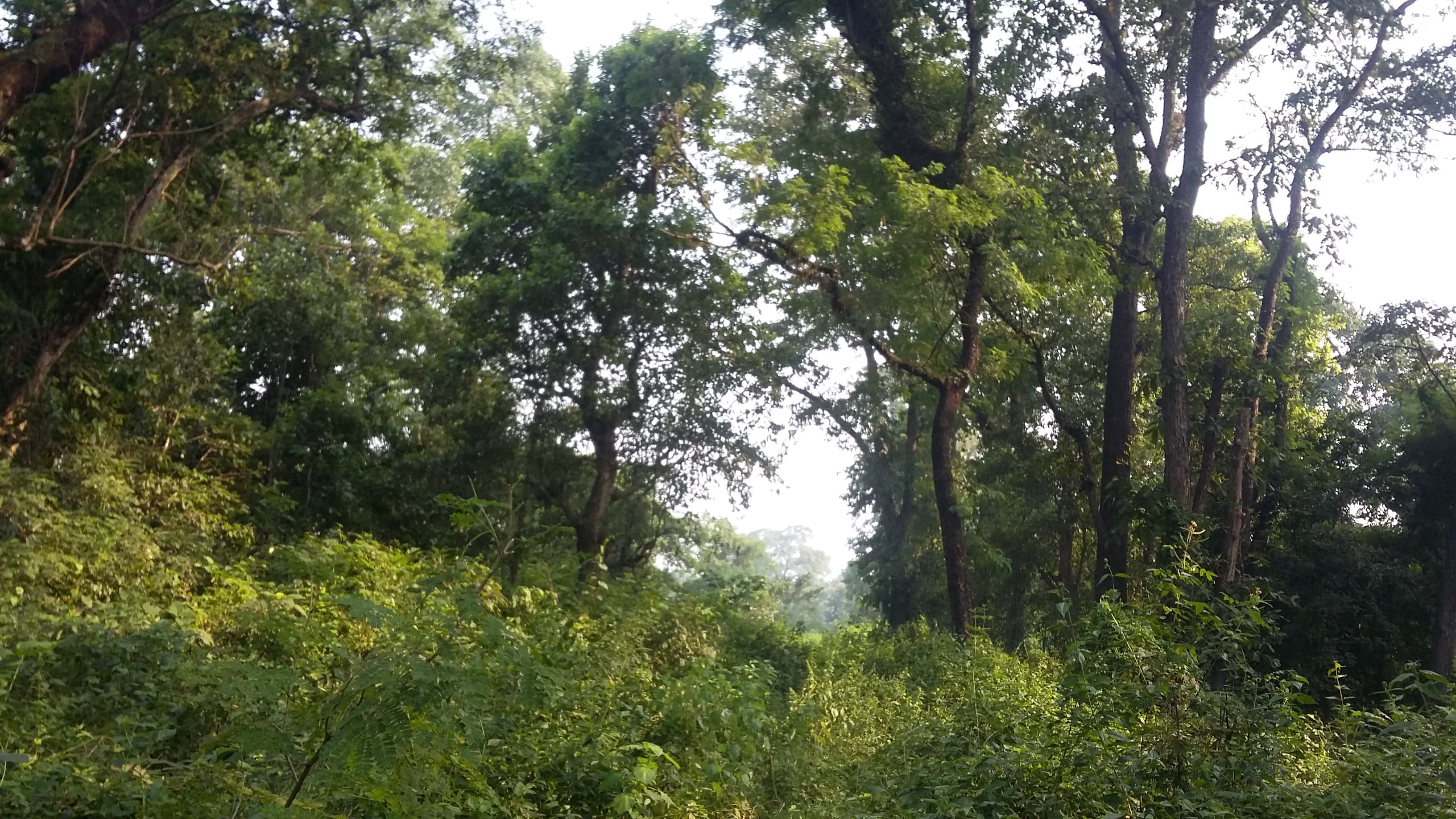
Chitwan is the historic centre — the first national park in Nepal (1973), the largest of the protected areas, and home to the country's biggest tiger population (128, 2022). Tigers here live in a mosaic of sal forest, riverine forest, and tall grassland on the Rapti and Narayani floodplains. Visitor activity is concentrated in the eastern Sauraha sector; tigers favour quieter parts of the park, but their presence is everywhere — in pugmarks, scat, and the alarm calls of chital and langur. More on Chitwan →
Bardiya has become the country's second great tiger park. The 2022 census put Bardiya at 125 tigers — only three behind Chitwan. The Babai Valley, returned to forest after farms were removed in the 1980s, has been one of the more remarkable recoveries within the recovery: a managed ecological reset that the tigers have moved into. Bardiya is also Nepal's quietest major tiger park; it sees a fraction of Chitwan's visitor pressure. More on Bardiya →
Parsa, immediately east of Chitwan, is the third pillar of the Chitwan–Parsa–Valmiki landscape. Tigers in Parsa rose from 18 in 2018 to 41 in 2022 — a more than doubling in a single census cycle, the kind of growth that signals real landscape connectivity at work. Parsa is largely undeveloped for tourism, which has been part of its conservation advantage. More on Parsa →
Banke, gazetted only in 2010 and paired with Bardiya as a single Tiger Conservation Unit, held 25 tigers in 2022. It is the smallest of the five populations but represents Nepal's strategic decision to expand tiger habitat westward beyond Bardiya's boundaries — a young park playing a long game. More on Banke →
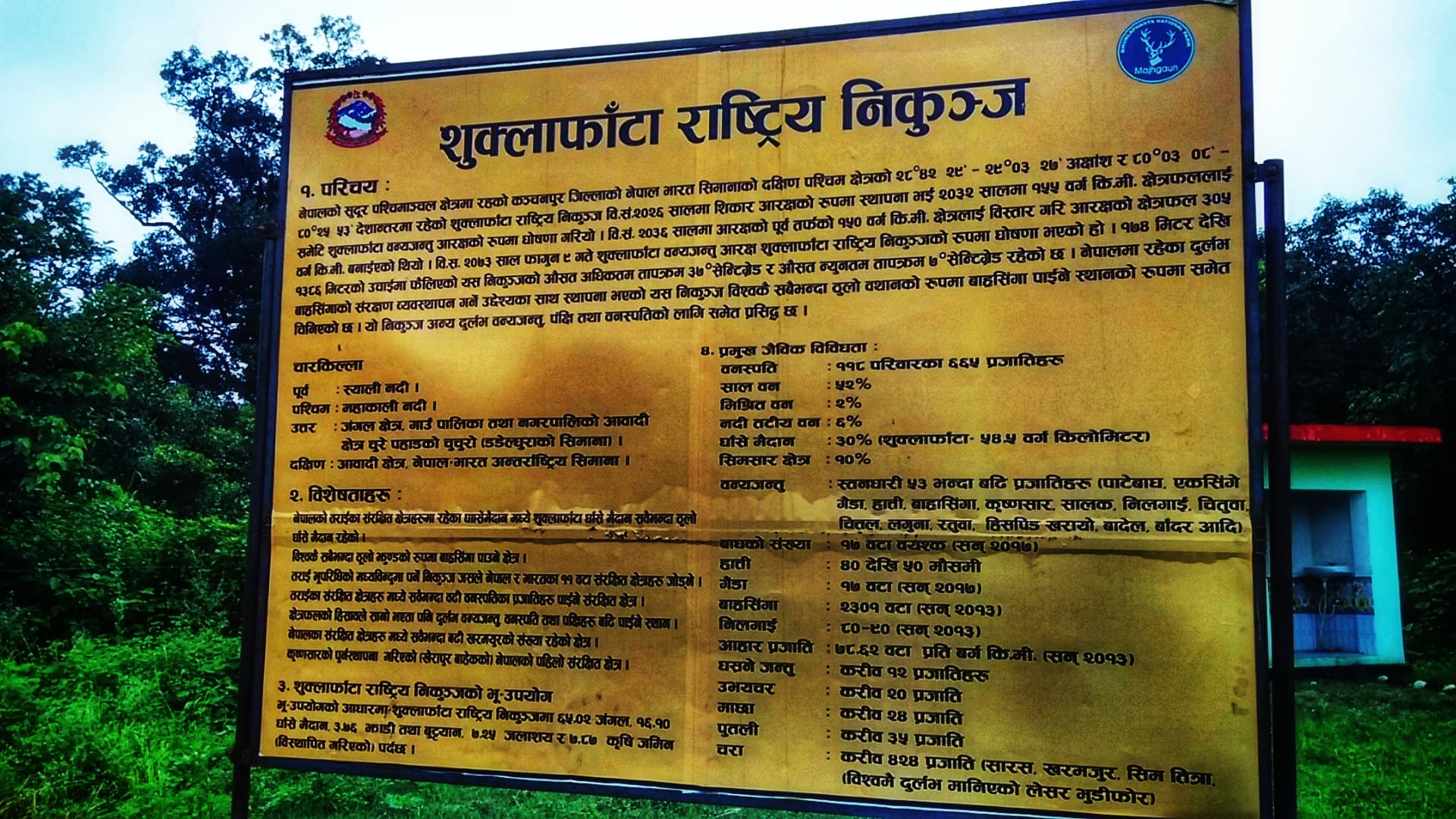
Shuklaphanta, in the far western Terai, had 36 tigers in 2022 (up from 16 in 2018). It is best known for grassland species like the swamp deer (barasingha), but its tiger population has been climbing steadily. Shuklaphanta's tigers are part of a corridor that connects west into India's Pilibhit Tiger Reserve. More on Shuklaphanta →
The next challenge: human-tiger coexistence
Nepal's tiger recovery is celebrated, but it is not uncomplicated. The success has brought a different, harder problem: more tigers, in landscapes also occupied by people.
Estimates from the period after the 2022 census suggest roughly three people are attacked by tigers each month in Nepal, when livestock cases are excluded. Most incidents happen in buffer zones, often involving people gathering firewood, fodder, or food from forest edges. Nepali conservation researchers and the Department of National Parks and Wildlife Conservation have been explicit that this is now the central problem of tiger conservation: not how to grow tigers further, but how to manage the country that growing tigers create.
Ecologist Ganesh Pant of DNPWC has noted that Nepal's protected areas could sustain perhaps 400 tigers — a figure not far above the current count, with the Chitwan–Parsa landscape alone modelled at ~175. The carrying capacity is real, and the policy question has shifted accordingly. The next phase is not maximising numbers; it is managing distribution, mitigating conflict, ensuring landscape connectivity, and securing the social licence that has underpinned the recovery.
The next census: 2025–2026
Nepal began its fifth national tiger census in December 2025, with results expected by July 2026. More than 2,300 motion-sensitive camera traps and roughly 250 conservation staff are involved, covering Chitwan, Banke, Bardiya, and Shuklaphanta. The census uses the same capture-recapture methodology as 2022, dividing the country's tiger landscape into three blocks: Chitwan–Parsa, Banke–Bardiya, and Shuklaphanta–Laljhadi.
By the time the 2026 results are released, this page will be updated to reflect them — with the previous figures kept on a clearly-labelled history line. Tigers, like the rhinos and snow leopards Nepal also conserves, are counted in cycles. The work of conservation is the work of holding the line between them.
Related on this site: Chitwan · Bardiya · Parsa · Banke · Shuklaphanta · The one-horned rhino in Nepal · Nepal's tiger parks, compared
Sources & further reading:
- Status of Tigers and Prey in Nepal 2022, Department of National Parks and Wildlife Conservation, Ministry of Forests and Environment, Government of Nepal.
- 2010 St Petersburg Tiger Summit Declaration (TX2 goal), Global Tiger Forum.
- Kathmandu Post coverage of the 2022 census (29–30 July 2022) and the 2025 census launch (16 December 2025).
- Reporting in Mongabay News, Dialogue Earth, and The Himalayan Times on tiger-prey dynamics, human-tiger conflict, and the Chitwan–Parsa–Valmiki landscape.
- WWF Nepal and NTNC carrying-capacity studies cited by DNPWC ecologists.
All figures verified against published sources, June 2026. Population numbers from the 2022 census; updated figures will be incorporated as the 2026 census results are released.