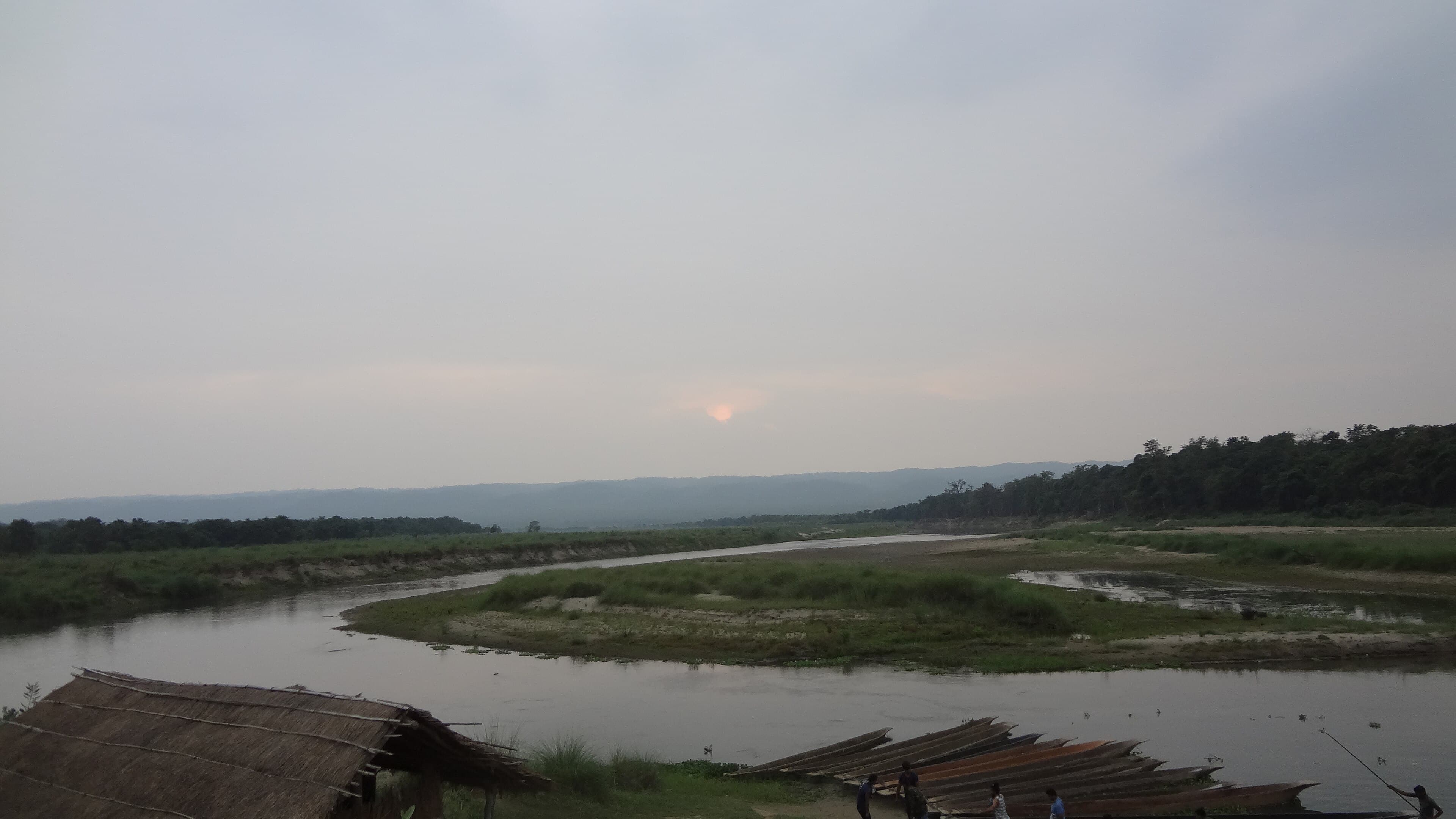
Wildlife of Nepal's national parks
Nepal's national parks protect one of the most ecologically varied landscapes on Earth. In a country roughly the size of Greece — and smaller than several US states — habitats range from the subtropical floodplain grasslands of the Terai to the alpine and nival zones of the high Himalaya, including the summit of Everest itself. The species that live across this gradient include some of the most studied, most threatened, and most globally consequential populations of their kind.
This section of the site sits alongside the park-led pages. Each park's Wildlife & Ecology entry tells you what lives there. The pages here tell you what each species is, where it lives across Nepal's parks, what has happened to its population, and what comes next.
We have started with four. They are not the only species worth a dedicated page — the red panda, the Himalayan musk deer, the Bengal florican, the Himalayan vulture, the gangetic river dolphin, the Himalayan tahr all deserve their own treatment in time. The four here are the ones whose stories most define Nepal's conservation arc, internationally and within the country itself.
The four signature species
The Bengal tiger
Panthera tigris tigris · Endangered
Nepal's wild tiger population nearly tripled in twelve years — from 121 in 2010 to 355 in 2022. No other country in the world met the global doubling goal of the TX2 initiative. The story behind that recovery, told park by park.
Found in: Chitwan · Bardiya · Parsa · Banke · Shuklaphanta
The greater one-horned rhinoceros
Rhinoceros unicornis · Vulnerable
From about 100 animals in 1966 to 752 in 2021. Nepal now holds the second-largest population of the species on Earth, behind only Kaziranga in India. A conservation arc that includes the founding of Chitwan in 1973, the insurgency-era poaching collapse, and the ongoing internal translocation programme.
Found in: Chitwan · Bardiya · Shuklaphanta · Parsa
The snow leopard
Panthera uncia · Vulnerable
In April 2025, after years of speculation, Nepal published its first consolidated national estimate: 397 snow leopards — the fourth-largest population on Earth. The high-Himalaya's ghost cat, finally counted. Includes the remarkable Sagarmatha natural-return story.
Found in: Shey Phoksundo · Sagarmatha · Langtang · Makalu Barun · Chhayanath
The gharial
Gavialis gangeticus · Critically Endangered
One of the most critically endangered crocodilians on Earth, and one of the few surviving wild populations is in Nepal. The Kasara Breeding Centre, opened in 1978, has released more than 2,000 captive-reared gharials into the country's rivers. The story includes the unresolved tension with the Bote fishing communities whose livelihoods sit on the same rivers.
Found in: Chitwan · Bardiya · Shuklaphanta
Why species pages, alongside park pages
A park page tells you what lives there. A species page tells you what lives where, across the parks — and what has happened to that species over time. The two views answer different questions.
Someone planning a visit to Chitwan benefits from the park page. Someone curious about Nepal's tiger recovery benefits from the species page. Someone researching Asian conservation policy may want both. Building them as separate but linked layers — each park page links to the species pages relevant to it; each species page links back to the parks it covers — gives readers a real choice about how to read the site.
How these pages are written
Every claim on every species page traces to a real source — peer-reviewed research, Government of Nepal data, the National Trust for Nature Conservation, the Department of National Parks and Wildlife Conservation, UNESCO, established conservation media. Numbers carry their year and the survey behind them. Where there is genuine disagreement between sources, both are surfaced. Where data is missing, the gap is named rather than filled.
We will update these pages as new census data is released. Nepal counts its tigers every four years and its rhinos on a similar cycle; the 2025-2026 tiger census and the pending next rhino count will both be reflected here when published.
What's coming next
In the order we expect to publish them:
- The red panda in Nepal
- The Himalayan vulture and the Jatayu Restaurant story
- The Bengal florican and Nepal's grassland conservation
- The gangetic river dolphin in the Karnali
Each will follow the same standard. We do not publish a species page without the depth and the sources to support it.
Related on this site: All 13 parks · The journal · Plan your trip · Sources & methodology