The gharial in Nepal: a survival held together by hand
In the mid-1970s there were perhaps 300 wild gharials on Earth. The species had fallen by some 96% in three decades — from a global population of 5,000 to 10,000 in the 1940s to a fraction of that by 1976. In Nepal, surveys at the time found about 70 individuals across the Koshi, Narayani, Rapti, Babai and Karnali rivers combined.
The gharial was, by any reasonable measure, on its way out.
In 1978, the Government of Nepal opened the Gharial Breeding Centre at Kasara, in the heart of Chitwan National Park. In the years since, the centre has released more than 2,000 captive-reared gharials into Nepal's rivers. The wild population has recovered. It has not flourished. The work is unfinished. But the species is, today, still here — and Nepal is one of only two countries in the world where its survival is possible.
The species
The gharial (Gavialis gangeticus) is unmistakable. A long, slender snout — adapted for fast sideways snaps to catch fish — distinguishes it from every other crocodilian on Earth. The snout carries roughly 110 needle-like interlocking teeth. Mature males develop a distinctive bulbous growth on the snout tip, a structure called the ghara (meaning "pot" in Hindi), which gives the species its name.
Adult gharials reach 4 to 6 metres in length. They are highly aquatic — far more so than their broad-snouted neighbour the mugger crocodile — hauling out onto sandbanks only to bask, nest, and rest. They are powerful swimmers; their hind feet are heavily webbed. On land they are clumsy.
The gharial is one of the most evolutionarily distinct crocodilians alive — the only surviving member of the family Gavialidae, the last remnant of an ancient lineage that once spanned much of the world. Genetically it sits alone; ecologically, it occupies a niche no other crocodilian fills.
It is harmless to people. The slender snout is built for fish and would shatter on larger prey. Stories of gharial attacks on humans are essentially unknown; the species is the gentle giant of South Asia's rivers.
It is classified as Critically Endangered on the IUCN Red List — the highest category short of extinct in the wild. Today the global wild population is estimated at around 200 mature individuals, found only in scattered river stretches in Nepal and northern India.
How the collapse happened
The gharial's vulnerability was a perfect storm of pressures, all acting on the same narrow ecological niche:
Habitat destruction. Gharials require deep, clear, fast-flowing river stretches with sandbanks for basking and nesting. Dams, irrigation barrages, water diversion for agriculture, and channel modification destroyed those conditions across most of the species' historical range. The rivers slowed, silted, and shrank.
Sand mining. Industrial-scale extraction of sand from riverbanks — for construction across the rapidly developing subcontinent — directly destroyed the nesting beaches the species depends on. Eggs need sandbanks. No sand, no eggs, no gharials.
Fishing pressure. Overfishing depleted the fish that gharials eat. Worse, gharials become entangled in fishing nets and drown — a single nylon gillnet can kill a thirty-year-old animal. Industrial pollution and pesticide runoff into the rivers compounded the loss of the fish population.
Egg collection. Gharial eggs were collected for food and traditional medicine throughout the species' range. A single nest of 30 to 50 eggs taken in March produces zero hatchlings in April.
Skin and folklore trade. Gharial skins were hunted for leather; the ghara and other parts were sold into folk-medicine markets across South Asia.
By the mid-1970s, the trajectory was unambiguous. CITES listed the species under Appendix I (the highest level of trade protection) in 1975. India started its captive-breeding programmes. Nepal followed in 1978.
The Kasara Breeding Centre
The Gharial Breeding Centre at Kasara, in Chitwan National Park, was established in 1978 with technical and financial support from the Frankfurt Zoological Society and is now managed jointly by DNPWC and the National Trust for Nature Conservation. The model is straightforward in principle, demanding in execution.
Eggs are collected from the wild. Each March and April, conservation staff locate gharial nests on the sandbanks of the Rapti and Narayani rivers. The eggs are excavated and brought to Kasara. This intervention exists because wild egg survival is catastrophic — predation by mongoose, monitor lizards, jackals, and people, combined with floods and habitat disturbance, kills the overwhelming majority of eggs before they hatch. Captive-reared, the survival rate climbs dramatically.
Eggs hatch in artificial incubators. Temperature is controlled; predators are excluded.
Hatchlings are raised for about five years. The juveniles are fed live fish in pools, growing to roughly 150 cm — the size at which they are large enough to survive in the wild against predators, fishing nets, and the river itself.
Released gharials are returned to the rivers. Wild-released animals are tracked when possible; some carry radio tags.
The numbers from the centre, as of mid-2025:
- 2,090 gharials released into Nepal's rivers since 1981, across six major river systems.
- The Rapti River has received the most: 1,335 individuals.
- The Narayani has received 419.
- The Saptakoshi 115; the Babai 110; the Karnali 41; the Kaligandaki 35.
- Recent translocations have extended releases to the Chaudhar river in Shuklaphanta National Park (25 gharials, March 2024) and the Rapti in Banke district (10 gharials).
- The breeding centre currently holds 782 gharials of various ages.
It is one of the longest-running and most ambitious crocodilian conservation programmes anywhere in the world.
The current wild population
The wild Chitwan population grew from 239 in 2023 to 265 in early 2024 — modest growth but real, and contextualised against decades when the wild population fluctuated below 100. The Chitwan population today is the most important wild concentration of the species in Nepal and one of only a handful of viable wild populations anywhere on Earth.
The species is also recorded in:
- The Babai river in Bardiya National Park — re-established through releases from Kasara.
- The Karnali river, also in Bardiya — small numbers.
- The Saptakoshi (Sapta Koshi) river — small numbers; one of the eastern release sites.
- The Chaudhar river in Shuklaphanta, after the March 2024 translocation of 25 individuals.
Despite decades of release, the wild population has not grown in line with the number of animals released. Of 2,090 captive-reared gharials returned to the rivers since 1981, the wild adult population remains in the low hundreds. The mathematics of mortality — fishing nets, sand mining, dam-related habitat fragmentation, pollution — has consumed most of the released animals before they have reached breeding age. Recovery, when it has come at all, has come only in the past decade and chiefly in Chitwan.
The Bote — and the conservation question Nepal has not solved
The hardest part of the gharial story is the part that doesn't fit neatly into a conservation narrative.
The Bote and other riverine communities of the central Terai have lived along the Narayani and Rapti rivers for centuries. Fishing was the foundation of their economy and identity. Gharials and Bote livelihoods occupied the same stretches of the same rivers for generations — without obvious conflict, because the fishing was traditional, small-scale, and seasonal.
Industrial fishing pressure, population growth, and the collapse of the fish populations themselves shifted that balance. As gharial conservation moved from polite request to active enforcement, the Bote found themselves bearing the cost. Fishing nets are the primary direct cause of gharial mortality in the wild. Conservation officials have, with steady firmness, restricted Bote fishing in protected stretches of the rivers.
The alternative-livelihood programmes — boat tourism, guiding, handicrafts — have not been enough to replace the income for many households. Conservation officers have acknowledged this openly; Mongabay's 2024 reporting on the issue carries direct quotes from breeding-centre staff saying so. The official position is that gharial conservation requires the rivers to be largely fishing-free in protected sections, and that the Bote must shift to non-fishing income. The Bote position, understandably, is more complicated.
This is the place where the gharial story is not yet a success. The animal is here; the population is slowly recovering; the breeding centre works. But the social cost has been borne unevenly, and the long-term conservation outcome depends on a livelihood transition that has not been adequately funded or designed.
The site does not have a tidy resolution to offer here. The case for gharial conservation is biological, ecological, and ethical. The case for the Bote is also ethical. Both are real. Nepal is still in the middle of working out how to honour both.
The science of recovery
A 2025 peer-reviewed paper in Reptiles & Amphibians — Population changes in Gharial (Gavialis gangeticus) vary spatially in Chitwan National Park, Nepal, authored by Bed Bahadur Khadka of the Kasara breeding centre with international collaborators — confirms that the Chitwan population has shown signs of recovery only in the past decade, with substantial spatial variation between river sections. Some stretches of the Rapti and Narayani are doing well; others are not.
The release programme alone has not been enough. What has shifted in the past ten years is the combination: continued release work, improved enforcement against poaching and net fishing in core stretches, sand-mining restrictions in protected zones, and habitat-protection measures along the rivers. These factors, working together, have allowed the wild population to begin growing on its own — not just being replenished from Kasara.
If the trend holds, the next decade may see Nepal become the country with the largest wild gharial population in the world. That is a remarkable thing to be able to say about a species that was 300 animals from extinction fifty years ago.
If the trend does not hold, the breeding centre will continue to hold the line.
What you can do as a visitor
If you visit Chitwan, the Gharial Breeding Centre at Kasara is open to visitors and lets you see the species at every life stage, from hatchling to release-ready juvenile. The visit is part of the standard Chitwan itinerary and is one of the more affecting experiences in Nepal's national parks. The entry fee contributes directly to the work of the centre.
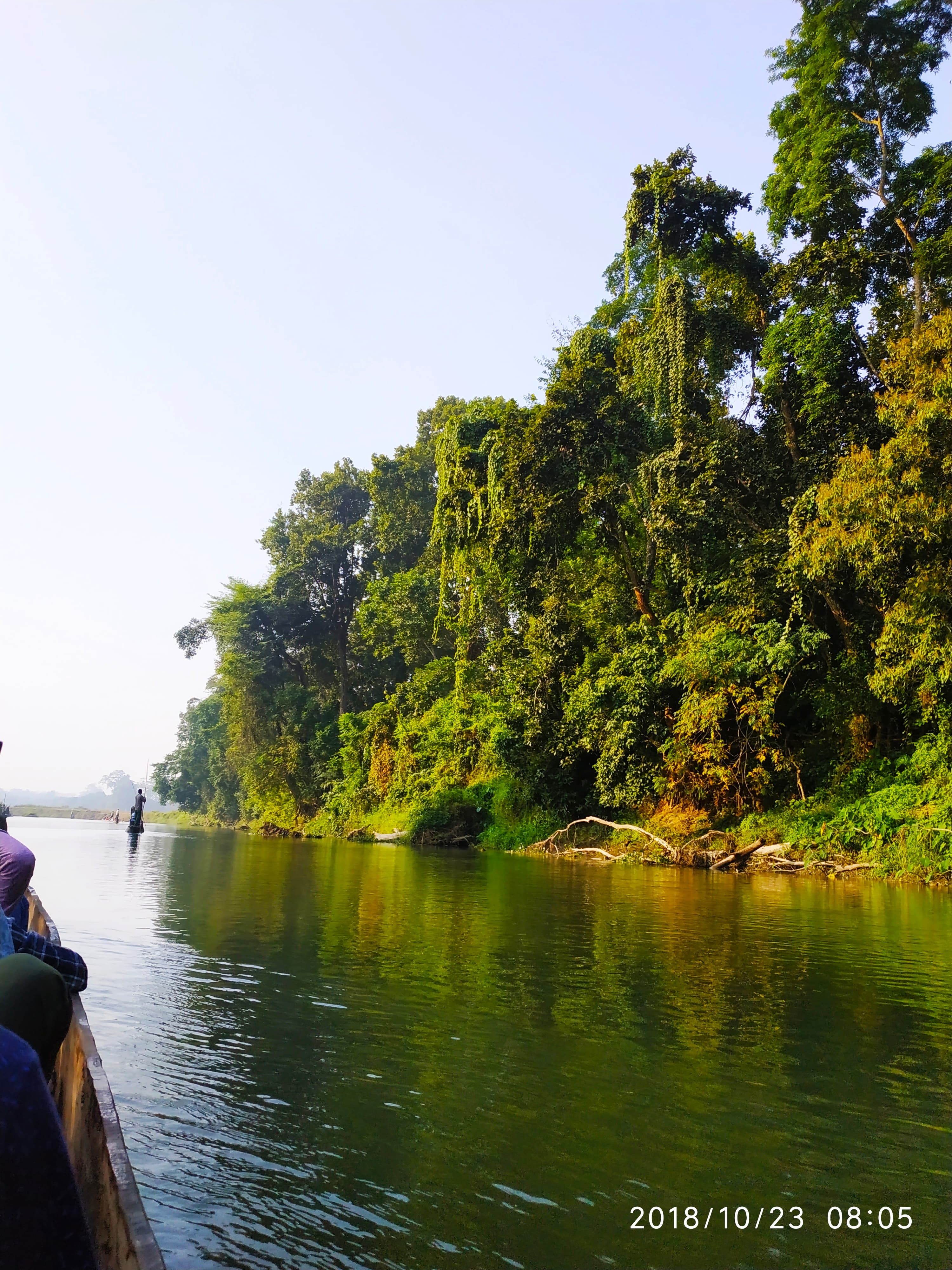
Dawn canoe trips on the Rapti offer the best chance to see wild gharials basking on sandbanks. They tolerate boat traffic at a distance; close approach disturbs them. Listen to your boatman — they know which stretches the animals favour and how close is too close.
Take photographs that respect them. Do not buy any product purporting to be made from crocodilian skin or parts in Nepal; the species' survival depends on the trade staying closed.
Related on this site: Chitwan · Bardiya · Shuklaphanta · The Bengal tiger in Nepal · The one-horned rhinoceros in Nepal · The snow leopard in Nepal
Sources & further reading:
- Gharial Breeding Center, National Trust for Nature Conservation — official programme overview and release statistics.
- Population changes in Gharial (Gavialis gangeticus) vary spatially in Chitwan National Park, Nepal, Khadka et al., Reptiles & Amphibians 31(1), 2025.
- 25 gharials from Chitwan's breeding centre translocated to Shuklaphanta, Kathmandu Post, March 2024.
- Chitwan's Bold Conservation Drive: 133 Gharials Released into Rapti River, Tourism Info Nepal, July 2025 — release-by-river statistics.
- Gharial conservation plan leaves Nepal fishing communities searching for new jobs, Mongabay News, February 2024 — the Bote livelihood story.
- Gharial conservation in Royal Chitwan National Park, Nepal — Gharial Status, December 2005, Ballouard & Cadi (SOS Crocodiles).
- IUCN Red List assessment for Gavialis gangeticus.
- CITES Appendix I listing, 1975.
All figures verified against published sources, June 2026. Wild Chitwan population from early 2024 surveys; this page will be updated as new survey data becomes available.