Getting around Nepal: from Kathmandu to the parks
Almost every international visitor's Nepal trip begins at Tribhuvan International Airport in Kathmandu. From there, the country opens out in three directions — east, west, and into the high mountains north — and the way you travel changes the trip almost as much as which park you visit.
This page walks through the practical realities: which parks are accessible by road, which need flights, what time those flights actually take when they take place, and what to do when they don't.
The basics: Nepal's domestic transport
Nepal has a small but functional network of domestic airports and a road system that varies dramatically by region. Three things to know before planning:
Domestic flights are weather-dependent. Nepal's mountain weather changes fast, and many of the airstrips serving park gateways — particularly Lukla and the small high-altitude strips at Jumla and Juphal — are visual-approach-only. If pilots cannot see the runway, they cannot land. Flight cancellations are routine in spring, autumn, and especially monsoon.
Roads are improving but slow. Nepal's road network has expanded enormously over the past decade, with new highways linking previously remote regions. But "highway" in Nepal often means a single mountain road, sometimes unpaved in sections, frequently affected by landslides during and after the monsoon. Estimated drive times are estimates; build in buffers.
Almost everything in tourism radiates from Kathmandu. Some routes go via Pokhara (the second city, gateway to Annapurna), and the far western parks may be more practically reached via Nepalgunj. But Kathmandu is the dominant hub and the starting point for almost every itinerary.
Park by park: how to get there
Chitwan National Park
Chitwan is the easiest national park in Nepal to reach. Two routes:
- By air: Kathmandu to Bharatpur Airport, ~25-minute flight. From Bharatpur, it's a ~30-minute road transfer to Sauraha (the main eastern park gateway). This is the standard option for tourists short on time, though delays and cancellations do happen.
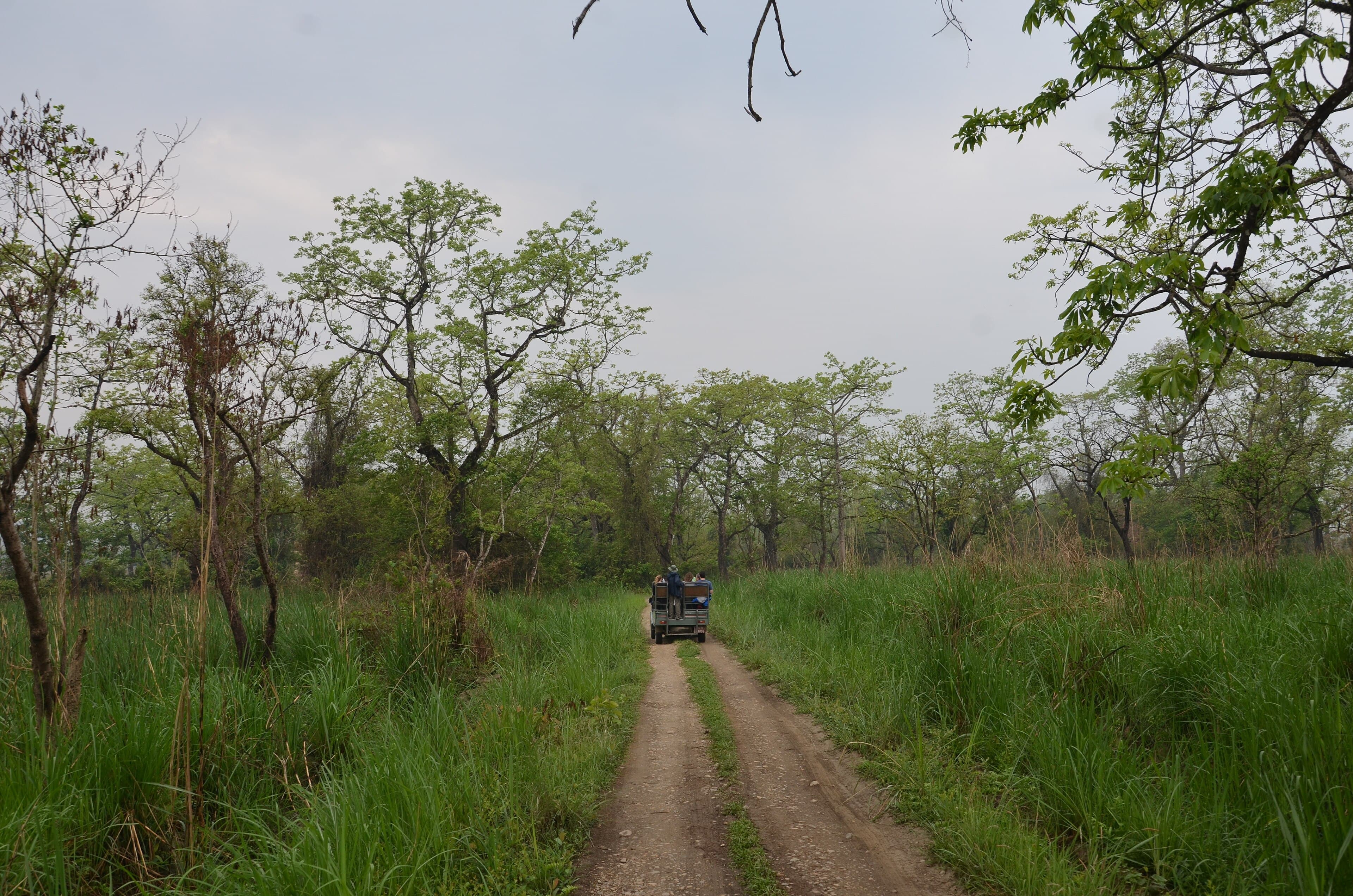
- By road: Kathmandu to Sauraha, roughly 5–6 hours on the Prithvi Highway via Mugling. Tourist buses run the route daily; private taxis or arranged transfers are common with lodge bookings. The drive is scenic and gives you a feel for the transition from middle hills to Terai lowland.
Both options work well. Most international visitors fly out and drive back, or vice versa.
Bardiya National Park
Significantly further west than Chitwan, and harder to reach.
- By air: Kathmandu to Nepalgunj (~1 hour flight), then ~3-hour road transfer to Thakurdwara (the park's main gateway). This is the standard route.
- By road: Kathmandu to Bardiya direct is a long journey, 12–15 hours, generally done overnight. Most visitors fly to Nepalgunj instead.
Bardiya's distance is part of why it's quieter than Chitwan. Plan a minimum of 3 nights to make the travel time worthwhile.
Banke, Shuklaphanta, Parsa
The other Terai parks are reached similarly to Bardiya and Chitwan respectively. Banke is adjacent to Bardiya — same Nepalgunj gateway. Shuklaphanta is far western, via Bhimdatta (Mahendranagar), accessible by flight to Dhangadhi or long road journey. Parsa adjoins Chitwan and shares its access logistics via Bharatpur or Hetauda. These parks see fewer international visitors and have less developed tourism infrastructure than Chitwan or Bardiya.
Sagarmatha National Park (Everest region)
The Sagarmatha trek begins at Lukla, a small mountain airstrip at 2,846 m. This is where Nepal's flight reliability becomes a central planning issue.
The current 2026 reality. Flights to Lukla are operated by Tara Air, Summit Air, and Sita Air. During peak trekking seasons (March–May and September–November), Lukla flights are now diverted from Kathmandu to Manthali Airport in Ramechhap — a 4–5 hour drive east of Kathmandu, typically starting at 2–3am to catch early-morning departures. This diversion was made permanent for peak season to reduce congestion at Tribhuvan International Airport, which now struggles to handle both international and domestic traffic.
During off-season (winter and summer), Lukla flights operate directly from Kathmandu.
The flight itself. From Manthali, the flight to Lukla is ~15–20 minutes. From Kathmandu (when operating), ~30–35 minutes. Either way, you're in a small fixed-wing aircraft (Twin Otter, Dornier) landing on a short uphill runway. Lukla is sometimes called the world's most dangerous airport; pilots earn the route through specific certification.
Cancellation rates. Sources consistently report 30–40% cancellation rates in peak season (October–November, March–April), and 60%+ in monsoon. November tends to be the most reliable month with around 10–15% cancellation. Early-morning flights (6–8am) are more likely to operate than later ones.
What to do when flights cancel. Three options, in rough order of practicality:
- Wait it out. If conditions improve within a day or two, you fly. This is the standard response for most cancellations.
- Helicopter charter. Shared helicopter rides cost roughly USD 500–1,000 per person; private charters substantially more. Many trekkers facing tight return windows take this option to avoid missing international connections.
- Trek out via Jiri or Salleri. Historically the only way to reach the Khumbu before Lukla had an airstrip, this adds 5–7 days of trekking and is genuinely only for purists with weeks of buffer. Not a practical solution for most.
The single most important planning principle for Sagarmatha: build at least two buffer days into your return travel before any international connection. Two days catches most weather windows. Insurance with weather-delay and trip-interruption cover (separate from medical) is worth seriously considering.
Langtang National Park
Langtang is the most accessible high-Himalayan park because the trek begins from a road head, not an airport.
- Kathmandu to Syabrubesi (the trailhead) by road: ~7–9 hours through the Trisuli valley. Tourist buses, jeep transfers, and shared vehicles are all available. The road is mountainous and improving but still slow.
No flight is required. This is part of why Langtang is increasingly popular with visitors who want a high-Himalayan trek without Lukla's reliability questions.
Shey Phoksundo National Park
Far western, high-altitude, and access requires both flights and remote logistics.
- Standard route: Kathmandu → Nepalgunj (1 hour flight) → Juphal (small mountain airstrip in Dolpa, another short flight) → trek begins on foot. Juphal flights are weather-dependent and infrequent; expect potential delays.
Shey Phoksundo and its onward route into Upper Dolpo are among the most logistically complex destinations in Nepal. Restricted Area Permits for Upper Dolpo require a registered agency and a licensed guide; this access cannot be self-arranged.
Makalu Barun National Park
- Kathmandu to Tumlingtar (small airstrip, ~45-minute flight), then road transfer to Khandbari, then trek begins. Tumlingtar flights are less reliable than the major routes but more reliable than some far-western strips.
Rara National Park
- Kathmandu → Nepalgunj (1 hour flight) → Jumla or Talcha (mountain airstrip) → 2–3 days trek to Rara Lake. Talcha is the closer airstrip but flights are infrequent and weather-dependent.
Rara is one of the most beautiful and least-visited national parks in Nepal, and the access logistics are part of why.
Chhayanath National Park
The newest park, gazetted in August 2025, with minimal visitor infrastructure. Access is via Gamgadhi (Mugu) — the same general approach as Rara but further into the trans-Himalayan landscape. Practically, most visitors interested in Chhayanath would combine it with a Shey Phoksundo trek and approach through the Dolpa road head. This is not a destination for first-time visitors to Nepal.
Khaptad National Park
Far western, no nearby airstrip serves the park directly.
- Kathmandu → Dhangadhi or Nepalgunj (1 hour flight) → road transfer to Silgadhi (Doti), then trek in. Multiple days of total travel from Kathmandu. Khaptad's remoteness is its appeal; getting there is part of the experience.
Shivapuri Nagarjun National Park
The exception to everything above — Shivapuri Nagarjun is on the northern rim of the Kathmandu valley. Day trips from Kathmandu by taxi or local transport, 30–60 minutes depending on which entry gate. No flights, no overnight, no logistics. The most accessible national park in Nepal by a wide margin.
Practical guidance
Booking flights. Domestic flights can be booked in Kathmandu (through agencies or directly with the airlines) or online via airline websites. Tara Air, Yeti Airlines, Buddha Air, and Summit Air are the principal carriers. Lukla flights are best arranged through your trekking agency, which handles the Manthali diversion logistics.
Tourist buses vs. local buses. "Tourist buses" are a category in Nepal — these are dedicated coaches serving the Pokhara, Chitwan and Lumbini routes, with assigned seats, reasonable comfort, and predictable schedules. They cost more than local buses but are well worth it for international visitors. Local buses are cheaper, slower, and not designed for tourists.
Private transfers. Many lodges arrange door-to-door private transfers from Kathmandu, often with English-speaking drivers. This is the most comfortable option and worth considering for the longer drives (Chitwan, Bardiya, Langtang). Costs vary; ask your lodge or agency.
Internal flight luggage limits. Most domestic flights allow 15 kg checked plus 5 kg hand luggage. Lukla flights are stricter — typically 12 kg checked and 5 kg hand. Excess baggage incurs a per-kilo fee. Pack accordingly.
Buffer days. For any flight-dependent destination — Sagarmatha, Shey Phoksundo, Makalu Barun, Rara — build in extra days. This is the most important single planning rule for Himalayan Nepal.
Next in /plan:
- What to pack — by park type
- Safety and altitude — the serious one
- Permits and fees — what every park costs
Sources verified June 2026:
- Multiple Nepali tour operators in consistent agreement on the Manthali/Ramechhap diversion (October 2022 onwards, made permanent April 2023): The Everest Holiday, Mountain Tiger Nepal, Mountain Rock Treks, Mystic Adventure Holidays, Alpine Ramble, Langtang Treks, Haven Holidays Nepal, World Alpine Treks.
- Lukla flight cancellation statistics consistently reported as 30–40% peak season, 60%+ monsoon, ~10–15% November.
- Domestic carrier list (Tara Air, Summit Air, Sita Air, Yeti, Buddha Air) from carrier websites.
Flight schedules, frequencies, and luggage limits change. Verify directly with the carrier or your agency before travel.