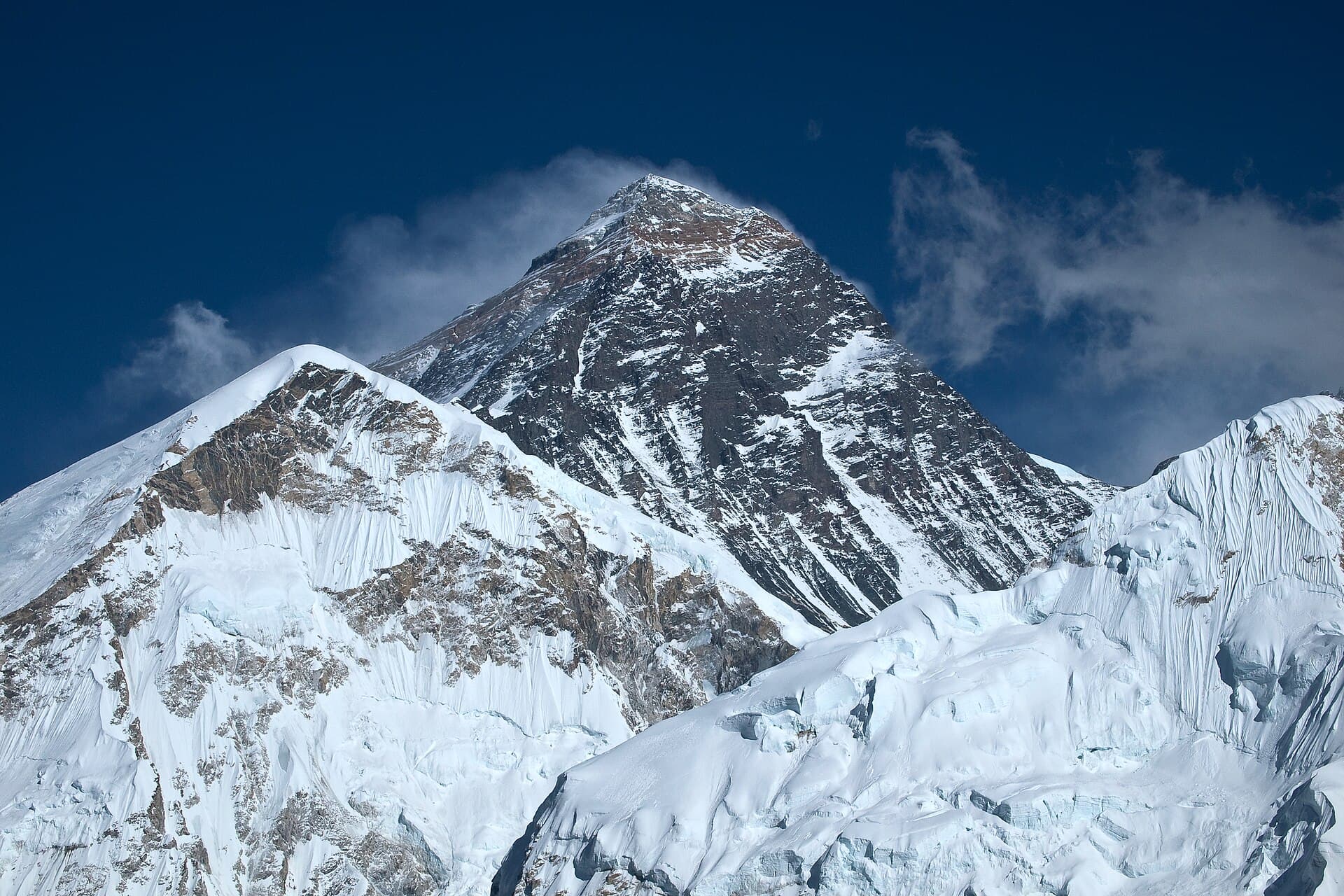
Mount Everest from the Khumbu region, Sagarmatha National ParkPhoto: Vyacheslav Argenberg · CC BY 4.0

National Parks / Mountain / Sagarmatha / Itineraries / Everest Base Camp

Sagarmatha Itinerary · 12 days

Everest Base Camp

The single most famous trek on Earth — Lukla to Everest Base Camp at 5,364 m and the Kala Patthar viewpoint at 5,545 m, with acclimatisation days at Namche and Dingboche. Twelve days door-to-door from Kathmandu; expect to add buffer for Lukla flight delays.

12
Days
Very hard
Difficulty
12
Stops

Before you book

What this itinerary assumes

Read this before committing. The day-by-day plan only works if these conditions are met.

Prerequisites

  • Comfort at altitude — prior trekking above 3,500 m strongly recommended, ideally above 4,000 m
  • No serious cardiopulmonary condition (consult a doctor if uncertain)
  • Reasonable fitness — 5–8 hours of walking on most days, some with significant elevation gain
  • Travel insurance that explicitly covers helicopter evacuation above 5,000 m
  • A registered Nepali trekking agency or experienced independent trekking team

What this itinerary includes

  • Lukla–EBC–Lukla on the standard route
  • Two acclimatisation days (Namche and Dingboche) built into the schedule
  • Visit to Kala Patthar (5,545 m) for the dawn Everest viewpoint
  • Tengboche Monastery, Khumjung, Sherpa villages

What it doesn't cover

  • Lukla flight cost (changes seasonally; verify with your operator)
  • Park entry fee, Khumbu Pasang Lhamu Rural Municipality fee, TIMS — all paid separately
  • Side treks: Gokyo Lakes, Three Passes, Cho La crossing (separate itineraries)

Day by day · 12 days

The itinerary

From Kathmandu and back, 12 days in total. Late September to November (cleanest views) or March to May (rhododendron bloom).

Kathmandu → Lukla → Phakding

Sleep
Phakding village · 2,610 m
Flight
Lukla flight 25–35 min from Kathmandu (or longer from Ramechhap in peak season)
On foot
3–4 hours

Early-morning STOL flight into Lukla — one of the world's most weather-affected airports. Once landed, begin walking gently downhill along the Dudh Kosi river to Phakding. The trek starts immediately; there is no road.

Note. Lukla flights cancel frequently. Build at least one buffer day at each end of your trek.

Phakding → Namche Bazaar

Sleep
Namche Bazaar · 3,440 m
On foot
5–6 hours

Cross the high suspension bridges over the Dudh Kosi, enter Sagarmatha National Park at Monjo (park entry fee and TIMS check), and climb the long final ascent to Namche — the Sherpa trading town clinging to the slope. First sight of Everest from the upper trail, weather permitting.

Acclimatisation day in Namche

Sleep
Namche Bazaar · 3,440 m
On foot
3–4 hours (acclimatisation hike)

Day hike to Everest View Hotel (3,880 m) and the Sherpa village of Khumjung. Walk high, sleep low — this is the first of two scheduled acclimatisation days and is genuinely not optional.

Note. AMS (acute mountain sickness) symptoms can begin here. If you have headache, nausea or sleeping difficulty, stay one more day rather than push on.

Namche → Tengboche

Sleep
Tengboche · 3,860 m
On foot
5–6 hours

Walk through rhododendron forest with views of Ama Dablam ahead. Descend to the Dudh Kosi, then climb the long final pull to Tengboche, home of the largest gompa (monastery) in the Khumbu. Time to visit the monastery in the afternoon.

Tengboche → Dingboche

Sleep
Dingboche · 4,410 m
On foot
5–6 hours

Out of the rhododendron belt and into the alpine zone. Pass Pangboche (4,000 m) and follow the Imja Khola valley. Tree cover thins; the air does too. Dingboche is a flat-roofed stone village built around stone-walled potato fields.

Acclimatisation day in Dingboche

Sleep
Dingboche · 4,410 m
On foot
3–5 hours (acclimatisation hike)

Hike up Nangkartshang Peak (5,083 m) or the ridge above the village for views of Makalu, Lhotse and Ama Dablam. Return to Dingboche to sleep. Second mandatory acclimatisation day — skipping this is dangerous.

Note. Above Dingboche, you are above 4,500 m for the rest of the upward route. AMS risk rises sharply.

Dingboche → Lobuche

Sleep
Lobuche · 4,910 m
On foot
5–6 hours

Slow ascent past Thukla (4,620 m) and the moving Sherpa memorial site for climbers lost on Everest. Climb the steep Thukla Pass onto the lateral moraine of the Khumbu Glacier. Lobuche is small and basic — expect cold nights and shared facilities.

Lobuche → Gorak Shep → Everest Base Camp → Gorak Shep

Sleep
Gorak Shep · 5,164 m (sleeping)
On foot
7–8 hours total

Morning push along the Khumbu Glacier's lateral moraine to Gorak Shep (5,164 m). Drop bags, then walk on to Everest Base Camp (5,364 m) — about 2–3 hours each way over rough glacial terrain. Return to Gorak Shep to sleep.

Note. EBC itself is a tent city for expeditions during climbing season and an empty moraine the rest of the year. Don't expect a view of the Everest summit from here — that's what Kala Patthar is for tomorrow.

Kala Patthar (5,545 m) → Pheriche

Sleep
Pheriche · 4,240 m
On foot
7–8 hours total

Pre-dawn climb of Kala Patthar (5,545 m) — the highest point of the trek and the iconic Everest viewpoint. Sunrise over Everest if the weather cooperates. Return to Gorak Shep for breakfast, then descend to Pheriche in the valley. Sleeping at altitude drops by over 1,000 m — relief.

Note. Kala Patthar is cold and windy at dawn. Pack proper insulation; the climb takes 2–3 hours from Gorak Shep.

Pheriche → Namche Bazaar

Sleep
Namche Bazaar · 3,440 m
On foot
6–7 hours

Long descent through Tengboche and back to Namche. Heading down feels notably easier — your body is recovering and the air is thicker. Namche feels almost luxurious after the high camps.

Namche → Lukla

Sleep
Lukla · 2,860 m
On foot
6–8 hours

The final long day back to Lukla — retracing the early-trek path through Monjo and Phakding. Most trekkers arrive at Lukla tired, satisfied and ready for the flight out.

Lukla → Kathmandu

Sleep
Kathmandu · 1,400 m
Flight
Lukla flight 25–35 min, weather-dependent

Morning STOL flight back to Kathmandu. Build at least one buffer day in Kathmandu before any onward international flight — Lukla cancellations can stack into multi-day delays.

Note. If the flight cancels, your options are a Manthali/Ramechhap reroute, a helicopter charter (expensive), or sitting it out in Lukla. Your operator should have a plan.

Honest framing

Things we want you to know before you go

Editorial caveats — the stuff a brochure leaves out.

  • This is the published consensus EBC schedule. Acclimatisation rest days at Namche and Dingboche are not negotiable — AMS kills trekkers in Nepal every year.
  • Lukla flight unreliability is the single biggest schedule risk. Plan as if at least one of your flights will be delayed by 24–48 hours.
  • Helicopter evacuation from Khumbu is available but expensive (USD 4,000–8,000 typical). Confirm your travel insurance covers this before you fly.
  • Some operators offer 'fast' 10-day EBC itineraries. We do not list them — the safety margins are too thin.
  • Everest Base Camp itself is not the Everest summit view. For the summit view, Kala Patthar on day 9 is the actual viewpoint.
Source. Standard EBC itinerary as published across reputable Nepali trekking agencies and major guidebooks (Lonely Planet Trekking in the Nepal Himalaya, Trailblazer Everest Base Camp Trek, Cicerone Everest Base Camp). Editorial review: 4 June 2026.

Other itineraries

Other ways to visit Sagarmatha